
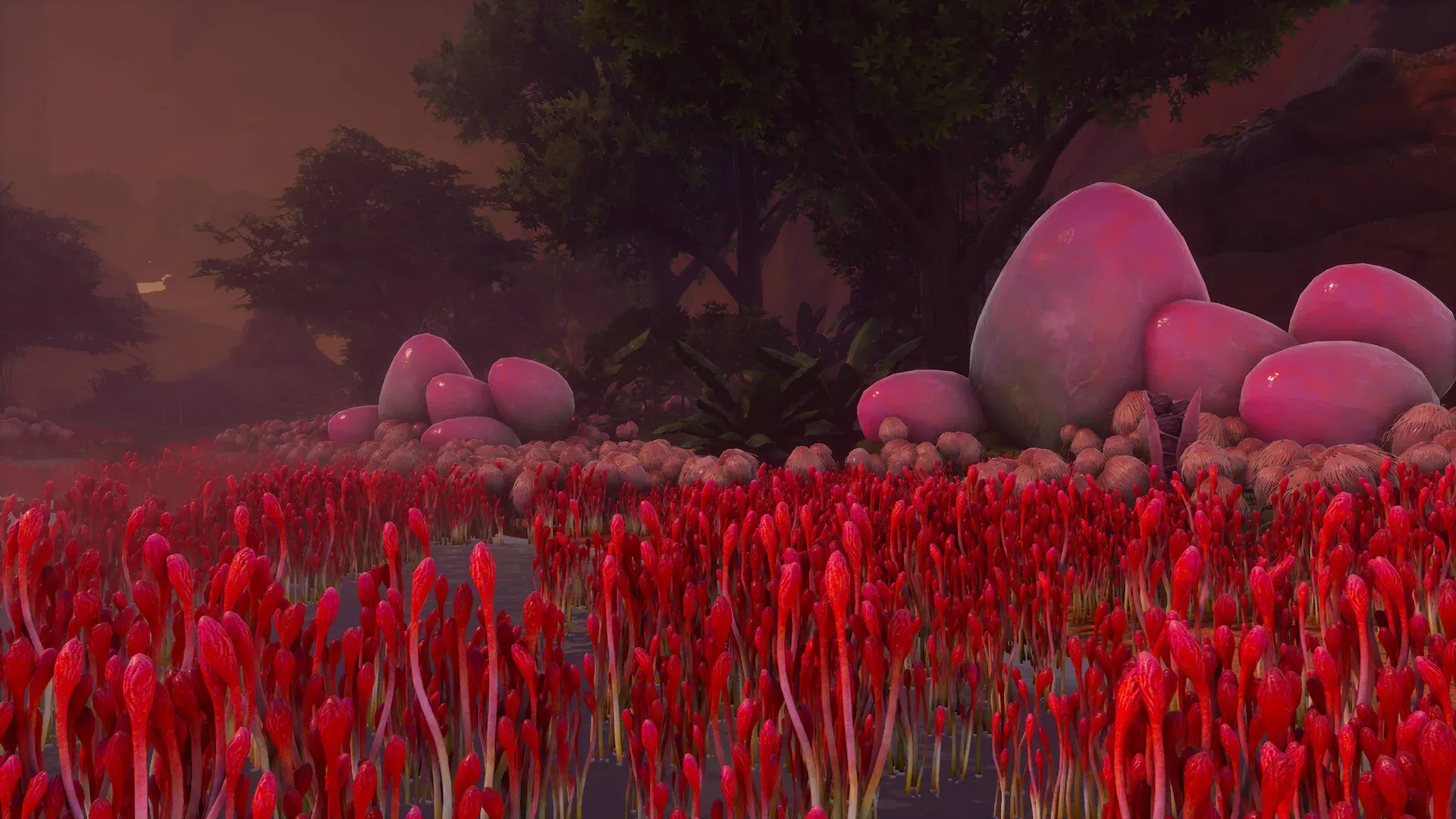
Official screenshot — Pokuch / META Publishing
Keep your outpost alive: the Organic Restoration System explained
The world fights back. Infection clumps grow on structures, dropped gear and cut stumps; if ignored, buildings disintegrate and items are destroyed. The counter is early, routine removal — ideally by hitting the infection core rather than its vines.
Brief / key takeaways
- Infection is triggered by player interference: building, cutting, dropping items.
- Dropped items pass through three stages: pink tint, vine-locked, destroyed.
- Structures can be consumed entirely and disintegrate.
- Target the core, not the vines; a patch made core hits clear the whole growth.
- Cut stumps can regrow the tree if you leave the infection alone.
How the system works
The official dev diary is unusually clear about the rules:
- Build a structure and small clusters — Infection Clumps — form around it. Left unchecked, they grow, spread and eventually consume the building, causing it to disintegrate.
- Cut a tree and infection begins at the stump, evolving from a minor cluster to full engulfment. If left alone, the infection eventually disappears and the tree regrows exactly as it was.
- Drop an item and it follows a three-stage decline: mild infection with a pinkish hue and reduced durability; vines appear and fix the item in place; the item is destroyed, leaving a fungal growth.
This is not a random event system. It is a response to player action. The developers describe it as “nature’s ability to heal itself and retaliate against human interference.”
A maintenance routine that works
- Walk the perimeter before you sleep. Look for pink nodules at the base of walls, around doors, and on any structure you placed that day.
- Clear the core. A demo patch improved infection destruction so that targeting the core, rather than the vines, destroys all infections and their vines. Aim for the centre of the cluster.
- Use acid where it is documented. Acid-infused weapons are the stated way to destroy the nodules blocking module entryways.
- Do not store loot on the ground. Use containers. Ground items are valid hosts and will be locked by vines.
- Leave wild stumps alone. If you want the tree back, do not “help” by clearing the infection. The natural cycle restores it.
Treat maintenance as a route, not a chore. A two-minute loop around the outpost after every expedition is cheaper than rebuilding a module.
Where to put things
The outpost location is fixed in the 2026 build — you restore an existing facility — but you still choose where to place extra stations and storage. Three rules follow from the system:
- Keep critical stations indoors or under cover. Weather and infection are both confirmed threats to structures.
- Do not build a second base deep in a biome you rarely visit. A base you do not maintain is a base being eaten.
- Keep a clear approach. You need to see the perimeter, and you need to reach it at night.
Co-op maintenance
Shared world state means one player’s neglect is everyone’s problem. Split the loop:
- One player checks the exterior while another checks the interior modules.
- Call out pink nodules like you would call out a hazard; they are easier to see from a distance than up close.
- Sleep readiness is a shared interaction. A patch fixed an issue where one player leaving the bed interface cancelled readiness for everyone, so coordinate before starting the sequence.
Questions
3 answeredCan infection destroy the whole outpost permanently?+
The dev diary says an infected building eventually disintegrates. Whether the outpost itself can be lost permanently, or only modules, is not confirmed.
Does cutting trees far from base still cause infection?+
Yes. The system is tied to the act of cutting, not proximity. The stump is the host.
Is there a way to prevent infection entirely?+
No prevention mechanic is documented. Maintenance and early removal are the confirmed counterplay.
Sources for this dossier
·