
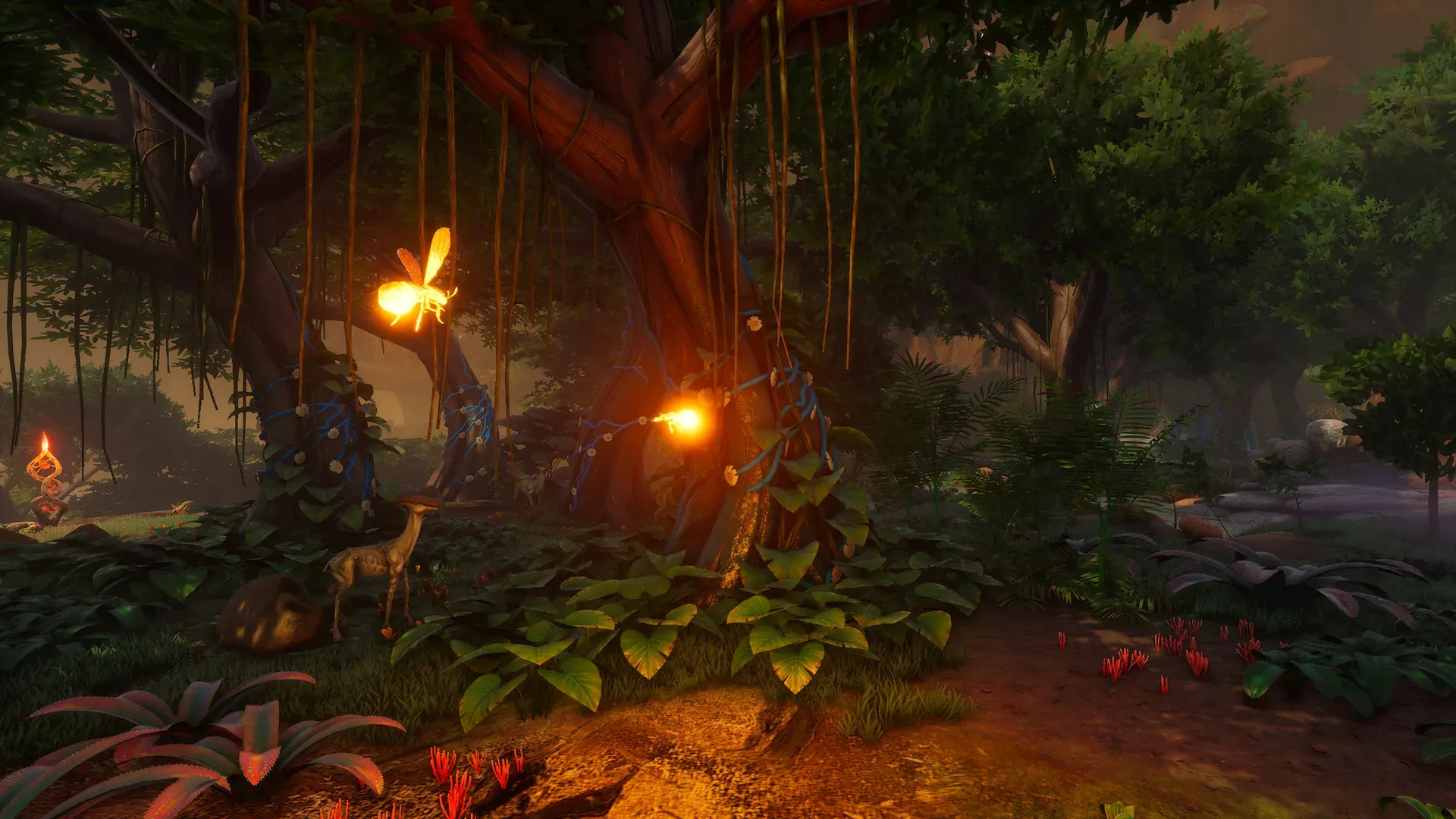
Official screenshot — Pokuch / META Publishing
Blind Descent beginner’s guide: survive the first two hours
Blind Descent is not a shooter with hunger bars. It is a route-planning game where water, infection and verticality decide whether you come back. The first two hours are about building a loop you can repeat, not seeing how far you can run.
Brief / key takeaways
- Find the scanner before you explore; it is the gate to every recipe.
- Secure water before you stockpile food.
- Your base is an inherited outpost that needs repair, not an empty plot.
- The Stone Mallet is a tool first and a weapon second.
- Infection is a maintenance debt. Inspect the base perimeter every time you return.
What kind of game you are playing
You are a Pathfinder for the Marsborn Mining Company, sent ten miles underground to find a silent Pioneer team. The elevator crashes. The surface goes quiet. What you find is not a mine but a jungle: humid, bioluminescent, and full of things that treat your suit as either food or an obstacle.
The official design pitch is “adapt, survive, and unfold the mysteries.” In practice that means three resources matter more than ammunition: information, water and mobility. Information comes from the scanner. Water comes from the outpost purifier or a boiled container. Mobility comes from climbing gear, a grappling hook, or mutations.
If you play it like a looter-shooter, you will run out of arrows, then out of water, then out of patience. If you play it like a surveyor, the map starts to make sense.
The first hour, in order
- Watch the opening sequence. In co-op, the build was patched so that joining players wait until the infection cutscene finishes. Do not skip it; it establishes why you are infected and what the vaccine is for.
- Apply the vaccine correctly. The co-op playtest had to clarify this: select the vaccine, then use the left mouse button. The old “Press E” tutorial prompt was later removed. If the prompt does not respond, try the primary mouse button.
- Find the scanner. The opening cave deliberately separates you from it. The official patch notes reference “the cave where you fall while looking for the scanner”, and an Acid Tree was added near the exit of that cave to teach hazard reading.
- Scan everything on the way back. Plants, fungi, insects, mineral nodes, the body in the cave. Scanning unlocks recipes and codex entries; an unidentified object is just weight.
- Do not fight the first large creature. The Martian Moose is peaceful until you stand between it and its food. Walk around. The Mosquito is not peaceful, but it is also not worth a close-range swing.
Your first meaningful decision is what to carry. Inventory space is limited, and the game expects you to choose tools over souvenirs. A stack of unidentified plants is not a resource; it is a slot you cannot use for water.
Water before food
Food is visible and satisfying. Water is the thing that actually ends runs. The documented water options are:
- The outpost purifier. Restore it with plant parts and keep it running. This is the long-term answer.
- Boiling. A campfire and a container. Patch notes reference a “no empty slots for water boiling” notification, so the game tracks container capacity separately from inventory.
- Crab shells. A patch specifically fixed water persisting in crab shells after save-load, which confirms shells can hold water. Whether they are reusable or placeable is still unclear.
Do not drink from the yellow pools. They are acid. The official screenshots show them glowing under green foliage; the colour contrast is the warning.
“The water doesn’t disappear from all crab shells after save-load.” — playtest patch note, v0.3.40
Your base is a repair job
The 2026 build replaced shack-building with restoring an abandoned outpost. That changes the first-day priority. You are not looking for a pretty clearing; you are looking for a facility with a generator, a purifier and modules you can bring back online.
Expect three immediate problems:
- Blocked entryways. Pink fungal nodules seal module doors. Acid-infused weapons are the documented way to destroy infection nodules.
- No power. Gather organic electrical fuel, connect the generator cable to exterior sockets, and manage module power timers.
- No clean water. Repair the purifier or fall back to boiling.
Once the outpost is breathing, resist the urge to decorate. The Organic Restoration System is already watching. Every structure you place and every tree you cut creates infection debt. Walk the perimeter before you sleep and after every expedition; the pink tint is the cheapest stage to fix.
Your first real tool
The best-documented early craft is the Stone Mallet: a Spotlight Stick handle, a Stone head and a Vine binder. The tool card describes slow, heavy swings that break surfaces and stagger large creatures. Treat it as a key, not a sword.
Combat is built around spacing and stamina. Two-handed weapons consume 50% of your stamina per shot, according to a 2026 balance patch, which means a heavy swing competes directly with sprinting away. A spear gives you reach; a bow gives you distance; a mallet gives you access. Carry two answers, not one.
If a fight feels unclear, leave. The game does not reward stubbornness; it rewards preparation. The developers explicitly designed dungeons to require food, water, armour and weapons before entry.
Five mistakes that cost first sessions
- Exploring without the scanner. You cannot craft what you cannot identify.
- Dropping gear on the ground. Dropped items get infected, then locked by vines, then destroyed.
- Cutting trees near your base for no reason. Stumps are infection hosts. If you leave them alone, the tree regrows; if you interfere, it may not.
- Carrying raw meat into a long trip. Food spoils. Dry or cook it first.
- Ignoring the Holowatch. The fog-of-war map is the only reliable way to stop moving in circles in a biome with few sightlines.
Questions
3 answeredDoes Blind Descent have a tutorial?+
Yes. The opening cave sequence teaches movement, the vaccine, the scanner and acid hazards. It has been reworked several times during development, so launch footage may differ from the October 2026 playtest.
Should I play solo or co-op first?+
Solo if you want to learn the systems at your own pace; co-op if you already have a group and want to split base maintenance. The world scales resource availability, enemy behaviour and complexity with player count, according to the developer.
Can I skip the base and live nomadically?+
The outpost provides the purifier, generator and stations that advanced crafting depends on. A nomadic run is possible in principle, but you would be giving up the documented water and cooking infrastructure.
Sources for this dossier
·